Showing posts with label History. Show all posts

Plan B:Outer Banks and the Wright Brothers

 Plan B was better. 

Plan A was to go to Williamsburg, VA with our friends to once again take advantage of Busch Gardens’ complimentary tickets for veterans. But…rain. I lived in Texas too long not to appreciate water falling from the sky, but on this occasion, those showers may have been accompanied by lightning. Wind. Maybe hail. Not wanting to crowd into shops during a shower, sit on wet seats between showers, or risk having to go home early because a storm shut down the park for a while, we opted for Plan B. 

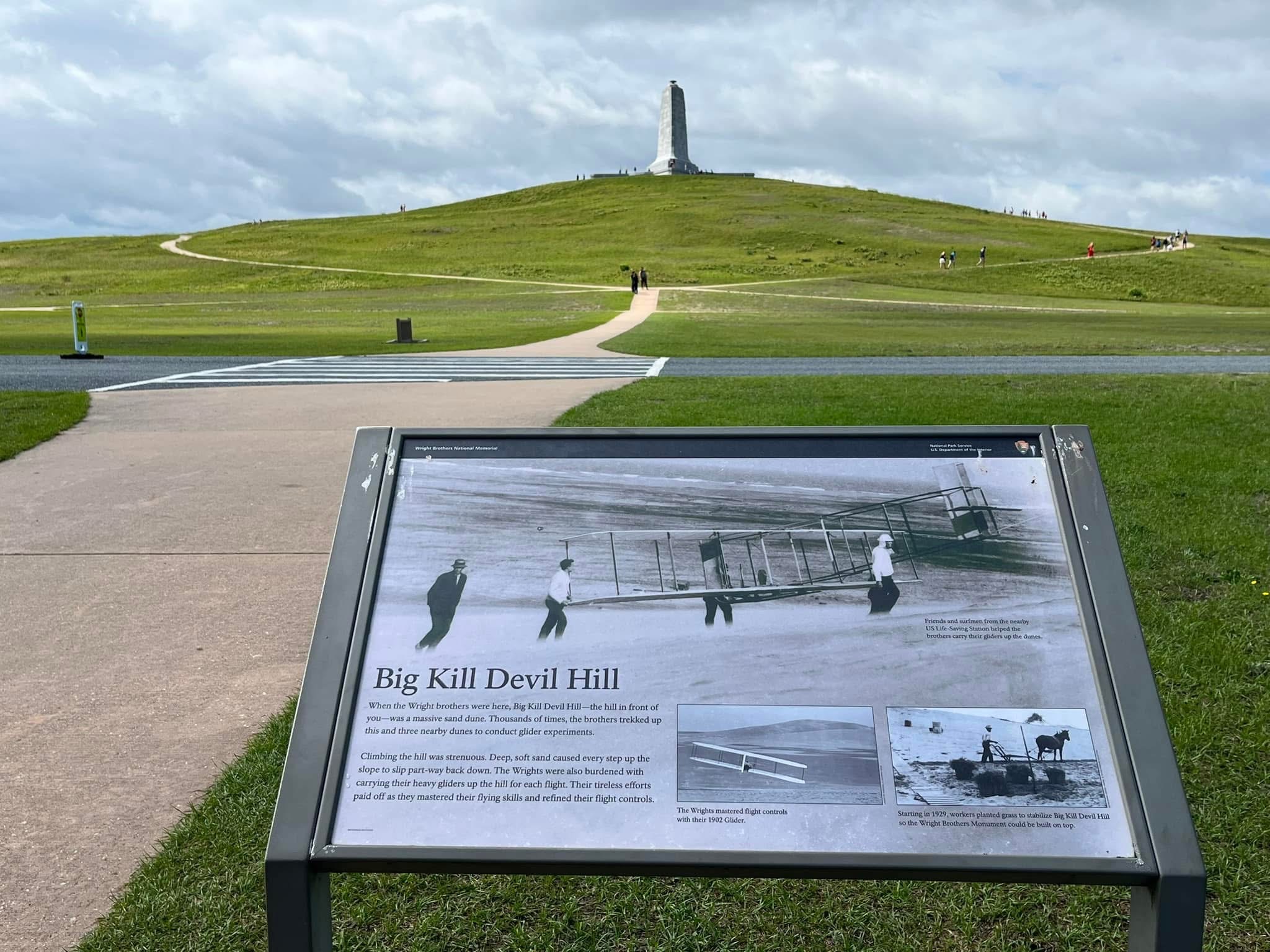
We had a lovely time in Kill Devil Hills sipping hot chocolate on a covered balcony overlooking the ocean while it rained, spending time visiting and talking, visiting the Wright Brothers Memorial (first time) and being blessed with the sight of a beautiful, enormous rainbow over the ocean, the photos of which do not do it justice. Oh, and watching a beautiful sunrise after the rain moved out. 

Yeah, Plan B was definitely better.


Spanish Incursion into North America: Ponce de Leon

 Our visit to St. Augustine a few years back set off a study of Spanish and French activity in what’s now the U.S. before the arrival of the English under Sir Walter Raleigh. I read numerous books on the subject, and just about the time I think I have it all figured out, I learn more. 

While the Spanish invasion in the New World began with Christopher Columbus, the Spanish incursion into the N.A. began with Juan Ponce de León. As I posted a few years ago when I saw a Visit St Augustine article (screenshot below):

“And so began the exploration of and attempts to settle what is now North America. Juan Ponce de León would attempt to settle a colony along the Florida coast in 1521.According to the one source, it lasted about five months until the colonists were attacked by natives. Other sources indicate the attack was immediate. Ponce de León died in Cuba as a result of the wounds he received from an arrow.”


The next attempt at settling America occurred in 1526. It, too, was short lived and ended in disaster, as did all attempts at settlement (until Jamestown) with the exception of the second Santa Elena on what is now SC’s Parris Island.

If you were under the impression natives had had no contact with Europeans until the English arrived at Roanoke, Jamestown, or Plymouth, you’re in for a big surprise. 

The Lost Colony: John White’s Journal

As I mentioned in a previous post, I began to question my previous conclusion of the fate of the Roanoke Island Lost Colony. The source of my doubts was John White’s behavior during his 1590 search for the colonists and his eventual abandonment of a group that included his only daughter and granddaughter. Further research was needed. One of the sources I used was John White’s journal of his final trip to Roanoke Island in 1590: 

http://nationalhumanitiescenter.org/pds/amerbegin/exploration/text6/white.pdf

Some details, while not quite answering my questions, swayed me into keeping an open mind as to the reasons White and company left without stopping at Croatoan. Other details confirmed the direction of my suspicions. Read it for yourselves a few times. Take notes. 

The Lost Colony: The Third Expedition

This series is meant to be a short overview of Walter Raleigh’s expeditions to the New World that culminated in the separation and abandonment of what is now know as the Lost Colony. At the end of this series, I’ll provide book recommendations. For now, it’s helpful to read the previous posts:

What we know of John White’s colony, later called The Lost Colony, is common knowledge: The group was supposed to have settled along the Chesapeake, but their Portuguese pilot, Simon Fernando, forced them to disembark on Roanoke Island. This just a year after Ralph Lane caused numerous problems with the natives. 

Within days, George Howe was brutally murdered by natives while searching for crabs. A couple of weeks later, White’s daughter, Eleanor Dare, gave birth to the first English baby born in the New World, Virginia Dare. Facing an imminent abandonment by Fernando and in need of supplies, the colonists sent John White back to England with the ships to tell Raleigh of their plight and to get aid. 
Grounds near Fort Raleigh

Where would the colonists stay in the meantime? They built homes on Roanoke, but according to all reliable sources, the colony planned to move fifty miles into the main. If Fernando really did abandon them on Roanoke, when did they come up with this plan? Surely not before they left England, as they were supposed to have gone to Chesapeake. And yet, the symbol for a fort located approximately fifty miles into the mainland was recently found on one of John White’s maps. A map that White had either left in England or had taken back with him. 

In his A Strange Kingdom book on the Lost Colonists, James Horn states the follow:

Then (White) and the assistants had to decide where the colonists would go when they left Roanoke Island. Mindful of the threat of attack by the Secotans, White and the settlers had decided to leave the island and move inland, where they hoped to find friendly Indian peoples to help them. The best prospect was somewhere near the head of Albemarle Sound, where the Chowanocs lived. White knew from discussions with Ralph Lane that both peoples had been loyal allies of the English the previous year. Possibly the aged Menatonon would be equally helpful to his settlers.

Horn doesn’t provide a footnote here, so we don’t know if his, “the best prospect was somewhere near the Albemarle Sound....” is based on a primary source, if it’s accepted speculation, or if he knew the symbol for the map had recently been found. It’s located on the northern edge of Secotan territory. Would they have gone there instead of the island of Croatoan (modern Hatteras) after everything that had transpired during past expeditions? And if so, why had they carved CROATOAN into a post and CRO in a tree?

While White was in England, war finally broke out with Spain, preventing his return. When he finally returned to Roanoke in 1590, he found the fort abandoned and nature taking over (indicating it had been abandoned for some time) his belongings strewn about and damaged, and no one around. Or so he reported. As mentioned above, he found CRO and CROATOAN carved on a post and a tree, indicating their destination. The token indicating distress was not included, so it seems they left peaceably and went with their friends down to what is now Hatteras Island and eventually assimilated with the natives. Pretty much everyone agrees that’s where they went. I agreed. Why not? 

Subsequent primary sources from other explorers seemed to settle the matter. Edward Bland explored “New Britainne” (Virginia and the northern part of North Carolina) in 1650—just over sixty years later. He traveled to the Albemarle Region (of which we speak) after hearing reports of Englishmen living among the natives. In his trip through the Carolinas in 1700, John Lawson reported meeting members of the Hatteras nation who had gray eyes and whose ancestors could “talk from a book.” In my mind, it was settled. While reading an advanced copy of Shannon McNear’s upcoming novel on the colony, even before I reached the part where John White had left for England, I started thinking about it and realized that couldn’t be the end of it. Not because there are so many theories about the fate of the colonists, but because of events that occurred upon John White’s return in 1590. 

Suddenly, what had been the obvious no longer made sense. I had to do more research and rethink everything.

The Lost Colony: The Second Expedition

This series is meant to be a short, light overview of Walter Raleigh’s expeditions to the New World that culminated in the separation and abandonment of what is now know as the Lost Colony. At the end of this series, I’ll provide book recommendations. For now, it’s helpful to read the previous posts:

First Post

1585-Raleigh’s Second Expedition under Sir Richard Grenville and Ralph Lane 

Northeast Shore of Roanoke Island as it Looks Today

This near year-long expedition was a huge disaster that ruined relations forevermore with the natives in this region and in the Chesapeake area. Before it even started, the captain of a ship called the Lion arrived first and “left 30 starving men and no supplies on Croatan Island” (now Hatteras.) Later, upon his arrival, Raleigh’s cousin, Sir Richard Grenville, “sent a ship to Croatan to retrieve (them) and the ship returned with two men and no explanation of the fate of the others.” They just disappeared. 

Before Grenville sailed off, he put Ralph Lane in charge of the soldiers and the English interest in the region. Lane’s mismanagement and abuses over the next year hurt relations with the Secotans and other confederations. There are too many wrongs to list, but it included mooching off the natives, burning a village over a missing cup, kidnappings and holding a hostage, a beheading, and natives dropping dead by the dozens after being exposed to pathogens their immune systems instantly attacked, killing their host in the process. It’s little wonder that Lane and his men left the following year when Sir Francis Drake arrived to check on them. Lane truly made himself and the English a stench in the noses of the Secotans and other confederations. 

On a side note, it’s said the privateering Drake may have been transporting slaves from Africa to or from the Caribbean and that he may have taken some off the boat to make room for Lane and his men. I read that these people are believed to be the ancestors of the Lumbee Tribe. 

All natives did not live in harmony with one another, especially the Secotans. They had enemies and they went to war with them. After everything that transpired, they were, in essence, at war with the English as well. 

Shortly after Lane abandoned his post, Grenville arrived on Roanoke and learned Lane and his men weren’t there. I don’t know if he knew they had left or if he thought they had mysteriously disappeared as the previous group of men had. Before taking off, Grenville left fifteen “well supplied men on Roanoke Island to maintain Raleigh’s patent” and went back to England. As with the previous group of men left on Croatan, they were never seen again. 

Can you see a pattern emerging?

—————————

Quotes are from Beechland and the Lost Colony by Philip McMullan. 

The Lost Colony: The First Expedition

A Look at Roanoke and the Lost Colony


As I mentioned in a previous post, there are so much facts and details involved in events that led up to the disappearance of members of Sir Walter Raleigh’s third expedition to the New World, numerous books had to be written to present it all. What follows is the barest of facts. If you would like to learn more, see my second post for a few resource recommendations. 

Raleigh’s First Expedition: 

In 1584, Walter Raleigh received a patent from Queen Elizabeth to establish a colony in the New World. He wanted to settle “at the edge of Spanish territory.” Queen Elizabeth refused at first, but changed her mind after the Spanish attacked English ships. 


In  July 1584, Philip Amadas and Arthur Barlowe landed on the Outer Banks of what is now North Carolina. They eventually made their way to Roanoke Island. The expedition was a smashing success. With the exception of one encounter that may or may not have happened, it was everything one would hope first contact would be and wished that it would have been throughout the ages. During their time there, they were hosted by members of the Secotan Confederation. 

For a short summary and chronology of the expedition, go to the National Park Service’s page on Amadas and Barlowe.

The Lost Colony: Influencing Factors

As I mentioned in my previous post, I recently worked through questions I had about the fate of the Lost Colonists. It's helpful to read that post first and then continue here.

-----------

History is cause and effect. We cannot look at one historical event without examining catalysts that led up to it, along with changes that came about as a consequence of that event. I couldn't begin to understand the Lost Colony until I had a grasp on the political, economic, and religious situations of the time, and the personal goals of those involved.

However, so much was involved with the arrival and disappearance of the Lost Colony, entire books had to be written to present all the facts. Books are still being written. There are several theories out there, but in trying to figure out what was bothering me about this situation, I decided to stick solely with known facts.

So I read. Much of what I originally gleaned all those years ago came from books such as Solving the Mystery of the Lost Colony by Lee Miller, The First Voyage to Roanoke 1584 by Arthur Barlow, and Thomas Harriot's A briefe and true report of the new found land of Virginia, along with a few other sources, including Ralph Lane's journal of his disastrous expedition. This past month, I downloaded Beechland and the Lost Colony by Philip McMullen and James Horn's A Kingdom Strange: The Brief an Tragic History of the Lost Colony of Roanoke. All of those sources taught me much about Roanoke Island, the natives who lived along the coast, and Raleigh's expeditions, but in these posts, I sometimes quote McMullen's Beechland and Horn's Strange Kingdom. While I don't agree with McMullen's theory for reasons I'll state later, he does a fabulous job of laying out chronological events that led up to the disappearance of the colonists. Quotes from both books are place in quote marks.

To start, it’s important to remember that Spain was a formidable power taking over parts of Europe, the Caribbean and South America. An expansion financed by what seemed like an infinite amount of gold mined in South America.

What is now the US Atlantic coast wasn’t a hidden gem Sir Walter’s men just happened to stumbled on. The Spanish knew about it. According to Horn's Kingdom Strange, Spanish ships sailed past the Outer Banks on occasion, and sailors had, one on occasion, wrecked their ship on one of the islands. Other nations were already fishing in the area around Newfoundland and likely around the area that’s now Nova Scotia and Maine. The Pilgrims were aware of them forty years later and had encounters with a few of them. 

With ships exploring and fishing in the waters to the north and to the south of the mid-Atlantic coast, once can assume a few of those ships sailed past it as well, including the Spanish. No one wanted the Spanish to take possession of more land and resources. In fact, England wanted to stop them all together. 

As Horn stated in his Strange Kingdom, “Ralegh would organize (but not lead) a large expedition to establish a harbor on Roanoke Island, from which English privateers could harass Spanish shipping in the Caribbean and western Atlantic, establishing a long-term English presence in the New World that would in time fatally undermine Spain’s empire.”

His first attempt to do so began in 1584. 

Next post: Raleigh's First Expedition


A Look at Roanoke: Explorers and the Lost Colony

Several years ago, the famous Lost Colony of Roanoke Island finally captured my history-loving attention. It began with an article I was writing on the charming town of Edenton, North Carolina. Even before that, I’d read Edward Bland’s The Discovery of New Brittaine and knew early explorers had traveled into the region to find the colonists. I wanted to know if there was a connection between that search and Edenton. The quest to answer that question immersed me in the centuries-old mystery, and I had a strong desire to learn all there was to know about the group that disappeared on the shores of the Graveyard of the Atlantic with little evidence as to where they’d goneI read books, spoke with local historians, read first-hand accounts written by participants in what, I learned, was three expeditions, not just one. After soaking it all in, I came to the simple conclusion that the colonist went to Croatoan just as they indicated they had, and that was the end of the story. 

After satiating my curiosity, I kept up on the continued search for the colony, but turned my attention elsewhere. Recently, though, I was offered the opportunity to read an advanced copy of Shannon McNear’s upcoming release, Elinor. Shannon was faithful to the facts, and the vivid picture she painted in her novel provided a realistic glimpse into what the colonists may have experienced. My interest flared once again, and as the colonists headed toward the New World in her novel, I also began to read non-fiction books on Raleigh’s expedition. Something was bothering me and I couldn’t put my finger on it. After typing out all the facts, I finally figured out what it was. 

And I changed my position. 

Over the course of the next week, I’ll present those facts in several posts, ending with my new guess as to the fate of 118 men, women and children, and two newborns, who risked their lives for a new start in a new land only to disappear from history. 

Year in Review - Journeys Expected and Unexpected

THERE AND BACK AGAIN

We traveled a lot this past year. More times than we'd planned. In February, we went to Florida to return my daughter's labs, who we'd been dogsitting while she and her family settled after a cross-country move. We also went to celebrate my grandson's tenth birthday. He wanted to go to Disney Animal Kingdom for his celebration. Since we love our grandson, we went. We had a good time and I loved the lushness of Animal Kingdom, but I learned never to trust my daughter when she said a roller coaster was fun. Moving backwards and getting jerked around unexpectedly was not fun!


We experienced another unexpected trip when we rushed back to the Sunshine State two months later after that same daughter underwent emergency surgery. Our presence relieved our son-in-law so he could return to work and the angst I felt being at being far away during such a time. She'll be dealing with some lifelong adjustments, but she's fine now.

In early summer, we flew to England to see our oldest daughter and her family, and to be there for the birth of her second son, our fourth grandchild. It was a wonderful time spent with family and visiting historic sites, including one tied to the great knight, William Marshal. Posts with photos here..

Sitting one the upper level of one of London's famous red buses for a tour of the city.

The Aforementioned Bus. While these tours provide an overview of London and some of its history, much of the city was blocked from view by the bus and other buildings. Next time, we'll walk.

Obligatory Photo of Stonehenge. Sheep really do graze nearby.

This past year, my husband celebrated his twelfth year at the church where he serves as pastor. After a dozen years in the pulpit, he needed a bit of a sabbatical, but with the birth and medical emergency, vacation time had to be reserved for family. Since the church office where I work was closed on Friday during the summer, we broke up that "sabbatical" into several weekends. We went to Edenton for Independence Day, the NC mountains, and Busch Gardens in Williamsburg, where we didn't ride a single roller coaster. Been there done that this year. (Or so I thought. Read on!)

Verandah at the historic Barker House, Edenton, NC


The one we didn’t ride. 

For our anniversary, we made a quick loop around eastern Virginia, visiting Manassas Battlefield, Arlington National Cemetery, the National Mall in Washington D.C., Mount Vernon, and finally, Fredericksburg Battlefield. It was all interesting, but the battlefields were particularly poignant experiences. Standing where so much blood was shed for independence from tyranny on one side, and to preserve the Union on the other brought home the fact that this history, these people, these battles were real. This nation needs to remember that to avoid another such terrible war.

Statue of Thomas Jackson overlooking the Manassas Battlefield.

Looking down the Sunken Road in Fredericksburg.

Reflection Pool at the National Mall in D.C.

Obligatory photo of the Unknown Soldier.
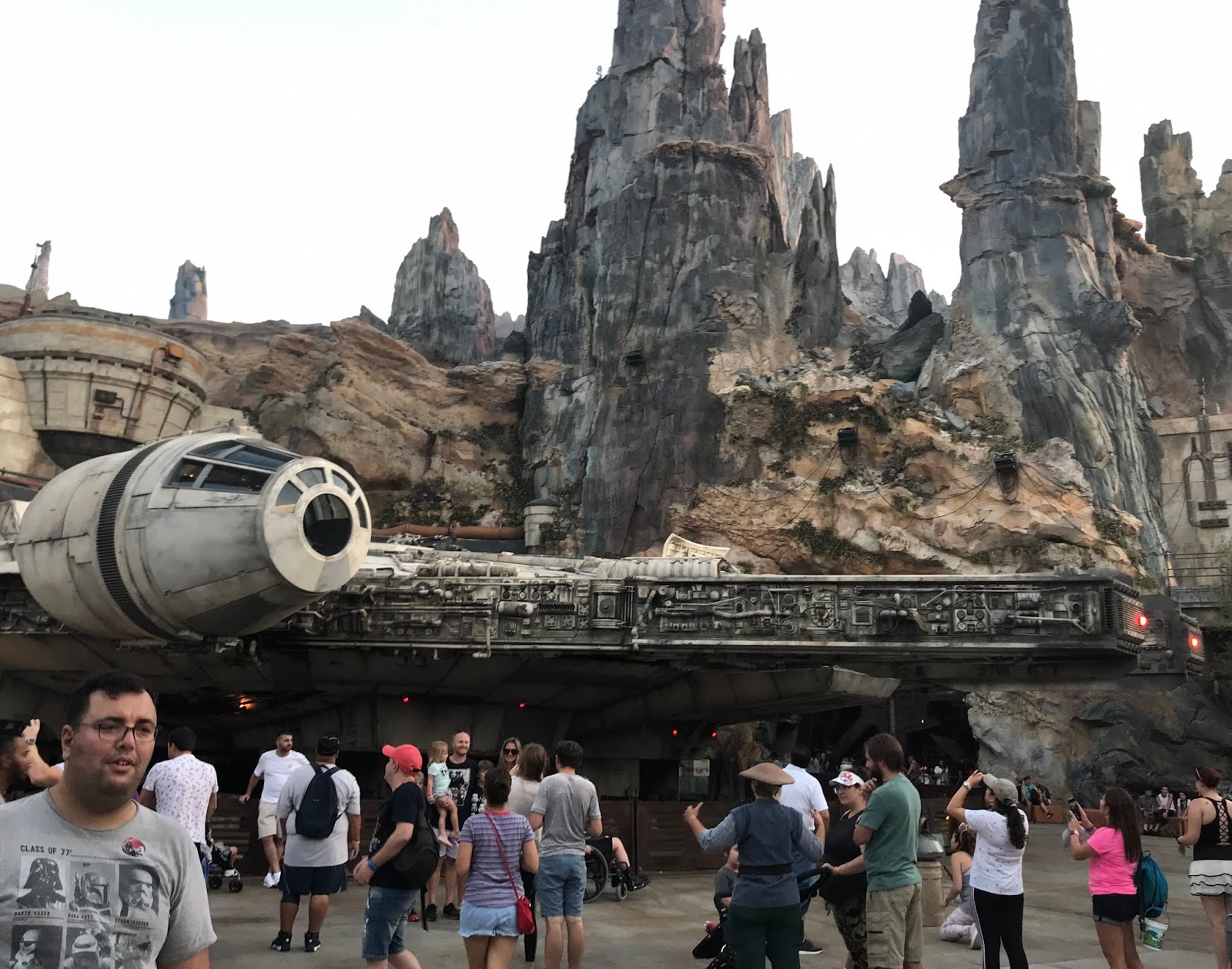
We thought that would be it for travels this year, but Southwest Airlines had a fantastic sale on airfare, which would allowed us to fly to Florida for another grandson's birthday for a great price. We booked the trip for what later turned out to be the day Hurricane Dorian arrived. Southwest allowed passengers to change flights without a fee, so we left the day after. We would spend less than forty-eight hours there, but within that time, our daughter dragged us back to Disney, where we rode a few more roller coasters and walked twelve miles in three parks.

After a week in which Disney was practically empty thanks to Hurricane Dorian, thousands of other eager visitors converged on the park. Yay.

Now this was a treat for this Star Wars fan!


Yeah, we love our grandsons.

And that wasn't all. We also traveled to the mountains of Virginia for Thanksgiving with friends. It was too cold to do anything outside, but we enjoyed our time visiting with them.

It's our Florida daughter's turn now. In just a few days, they'll arrive to spend Christmas week with us. More family time, more memories. I can't wait.

Next Post: Goodbye and Hello


The General

Anyone who knows me knows I love history. My favorite subjects are the War Between the States and Medieval England. Regarding the former, I'm a huge fan of Thomas "Stonewall" Jackson, Robert E Lee and (this may surprise some) Ulysses S Grant.

My respect for Grant grew even more after I read volume one of his beautifully written memoirs. When a friend recommended The General's Wife: The Life of Mrs. Ulysses S Grant, I downloaded the Kindle version and was pleased it covered as much, if not more, about US Grant as it did his wife, Julia Dent Grant.

The author reiterated much of which I knew about Grant, his humility, and his failures at just about everything in his early adult years with the exception of the one job he disliked—being a soldier. The book goes in-depth about his personal and family life. I learned he loved his family and often had them at his camp during the war, and that prior to that time, his father viewed him as a failure and often let him know it. However, once “Ulys” became a general, the man couldn’t brag about his son enough.

I'd always heard Grant was an alcoholic, but that may not be accurate. Several men accused him of intemperance, but those closest to him reported he rarely touched alcohol. On each account mentioned in the book, he was cleared of the accusations.

On the subject of journalists, he disliked them as they often twisted the truth, rarely in his favor. He suffered from migraines and had one shortly before Lee surrendered. It doesn’t appear he was a man of faith, but that only means the author didn’t say one way or the other. I hope he was. I'd love to meet him in heaven.

And yes, the book talks about Julia Dent Grant as well. Though she was plain looking, as the author pointed out, Ulysses adored her as much as she adored him, regardless of their wealth, or lack thereof, or situation. She was a bright, capable woman who stood by Grant's side, even during the battle of Vicksburg, some action of which she witnessed. A good book about an extraordinary man.


England Part II: The Anglo-Saxon Part of the Journey

Two years ago, I downloaded a book on the Battle of Hastings. It was so rich and engaging, it set me on a long journey through English history, first jumping back to King Alfred, the "White Horse King" and then forward through the Plantagenet era, up to the Wars of the Roses.

Two historic figures stood out in those pages for their bravery and character: King Alfred the Great and the great knight, William Marshal, the epitome of loyalty and chivalry. I had hoped to visit a location associated with either of those men, but as this trip was more about family and less about sightseeing historic England, I put that aside for another time.

But my family had other ideas. Stonehenge is located in Amesbury, in what had been Alfred's kingdom of Wessex, so it was pointed out to me that he likely saw the monument in its better days. From that point on, I began viewing Stonehenge from the perspective. A day after that trip, the English branch of our family tree took us to Earls Barton to visit a medieval church, the tower of which dated back to the 900s--in other words, the Anglo-Saxon era. Likely when Alfred's fourth great grandson, Edgar the Peaceable, was on the throne.

As one who loves history, I was overwhelmed--in a good way--to see, step into, and touch a structure so old (though at one point, I was so focused on everything around me, I stepped off the handicap ramp at the entrance and fell into the handrail. We had a good laugh about that.) With the constant medieval wars and Viking raids that occurred over the generations, can you imagine what that church has, "seen?" Despite those battles, time and weather, the church still stands.

Watch your step!

Inside the church. This was built, I believe, during Norman times.

Medieval doors and windows would make a fascinating study

Like Irchester, the village of Earls Barton is quaint and clean, with an abundance of flowers bringing color to the tanish-colored stones. After we left the church, we went across the street to a butcher shop where we purchased fresh meat for meals and other goodies to snack on during the drive to my daughter's final doctor appointments. However, as I would soon learn, the history portion of our trip wasn't over.


The American Tapestry

Have you heard of the Bayeux Tapestry? It's a near 230-foot exceptional embroidery that tells the story of the Battle of Hastings. In AD 1066, William of Normandy crossed a turbulent English Channel and conquered England, taking the crown from Harold, who had ascended to the throne after the death of his brother-in-law, King Edward (later known as Edward the Confessor.)

But there is more to that story that just the basic facts, and the creators of the Tapestry knew it. So much so, they didn’t begin in 1066 with William’s conquest. Instead, they started in 1064 with a scene depicting an exchange between Edward and Harold. Why? Because, what transpired between them was the motivation for William’s invasion.

As the Tapestry indicates, history is chronological; a linear stream of complex “causes and motivations, rather than simple dates and events.” (She says, quoting a different source.) And the Americas’ stream of causality dates back centuries before the Spanish stepped foot in the New World.

As one must view the Bayeux Tapestry from the beginning to understand the Norman invasion, its motivation and full impact, so too should one go back centuries before to fully understand the American Tapestry. Back to the time of William (which is why he is—or he once was—brought up so often in history classes and legal courses), to the abuses of the Plantagenet kings, and the eventual issuing of the Magna Carta and the subsequent abuses of King George.

Too many fail to do so and instead, view history from the beginning of the colonies to our present-day world. In doing so, we don't realize we're looking at a few panels of a much larger picture. Many also tend to view American history through the lens of modern thinking. This results in a condemnation of just about everything our forefathers did without an accurate understand of the complex causes and motivations that drove them. 

We blame the settlers for taking land from the natives. Today, such an act is reprehensible, as it should be. Invasions of lands by a foreign entity is comparatively rare and is often met by a coalition of allies gathering to stop it, such as we saw in the fight against the Japanese and German Empires during WWII. Not so in past centuries. Invasions were a common occurrence, with kings and peoples constantly fighting for territory. From Muslims and Crusaders slaying one another for possession of the Holy Land, to the Vikings and the constant warring between England and France (and other countries I’ve yet to read about) land constantly changed hands at the expense of the common people. 

Greed and the violence it takes to obtain that which people covet is the nature of fallen human beings.

With that history behind them, the Spanish didn’t think twice before moving into and conquering what is now Mexico and South American. In their eyes, they were justified, and they reaped a treasure trove of gold and silver for their efforts. Since they were the invading Japanese and Germans of their day, it shouldn’t be a surprise that, for various reasons including security, England—who had been on the verge of falling to Spain—established colonies in the northern region of the New World, in part to stop the flow of gold that financed the invasions.

In doing so, they took land from the natives, as did those who followed for religious and financial reasons stemming from intolerable causes of the time. Unconscionable today, but again, it was typical of the time. Even natives routinely slaughtered one another and fought for territory (sorry, but they weren’t peace loving folks who lived at one with nature. The various nations had warriors, arrows, and tomahawks for a reason, which predated the arrival of the Spanish and Europeans.* And it wasn't just for hunting. People are people, wherever they are.)

In other words, no one was acting out of character back then. They were following the “causes and motivations” of the day and emulating behaviors from the generations before them. The same with slavery. Too many believe the African slavery era rose and set with America, when it actually dates back to the 7th century. While first primarily localized to the Middle East and Asia, it crept into Europe sometime around the 14th or 15th century. So it naturally followed to the Americas. Only a small percentage were barbarously shipped to the US Colonies. Millions upon millions were taken to South America and the Caribbean to work dangerous sugar plantations. In the United States, it first ended in the north and then in the south, and finally, in the Caribbean.

We cannot change the facts of the past. Since history is linear, it’s done with and gone. While the world is still filled with fallen people who prefer to hurt and crush others, in so many ways, the world is better than it was back then. And yet, too many are stuck in the mire of the past. However, the past is a mental abyss that can bring no comfort or resolution.

On an individual level, we advise people to come to grips with their past whether or not the offending party acknowledges their role in the pain, to take the lessons and growth born from the experience, and to move forward living life as a better person. I think that’s great advice.

We can continue the national anger and hate, but to what end? The past is gone. Let's use it as motivation to be better and to move on.


* Initially, the natives and settlers did try to live together in peace and mutual trade, but increasing abuses on both sides damaged the relationships until one power overcame the other. Again, brutal and wrong, but typical for the age.

Catching Up

I finally had the opportunity to go back to work. An opportunity I jumped on. It's good to be busy and productive in a job that pays again.

In my spare time, I continue to knit. I have a specific goal in mind but need more information before I can post details. 

Writing continues, as does reading and historical research. I'm currently reading books regarding two of Sir Walter Raleigh's expeditions to the New World, including the Lost Colony. The issues and circumstances involved were far more complex than I had realized. If anyone in the third colony had survived, it would have been a miracle. 

We may have rains from a tropical storm heading our way. This weekend should be interesting. If we're privileged enough to see one of those spectacular sunset the day before, I'll post a photo.  

Zouaves..Wait, What?

I'm a curious person, and my curiosity often sabotages my plans. I can be in the midst of tasks, but get sidetracked when something of interest pops up in my memory or in a conversation, and I have to research it before I forget I was curious about it in the first place.

Earlier this week, I spotted "Zouave" while reading Bushwackers. I instantly recognized the term. After all, little Rene Picard and his flamboyant Zouave costume are mentioned several times in Gone with the Wind, and the character is seen in the movie. Zince, I mean, since the term sounds French, Rene's name is French, and he has a French accent, I assumed Zouave was a French unit and left it at that. So what if Rene hailed from Louisiana. They have a strong French presence there, no?

Years passed, and the word once again jumped at me as I read about Thomas' Legion. In that chapter, I learned Zouave was part of the name given to the first Indian unit formed in western NC, the Junaluska Zouaves. I saw no indication of anything French related to the unit or even the commander, so my curiosity was duly peaked.

It didn't take long to find the answer. Merriam-Webster defines Zouave (from what I've gleaned, it's pronounced zoo-ah-ve) as "a member of a French infantry unit originally composed of Algerians wearing a brilliant uniform and conducting a quick spirited drill". 

Wikipedia and two other sites confirm Zouave was the title given to some French infantry regiments, natives of, or serving in North Africa "between 1831 and 1962". However, as Merriam Webster confirms in its definition, other armies adopted the term, in particular, volunteer units. Apparently, the most famous of which in American history was the 5th New York Volunteer Infantry who served in the War Between the States.

I'd dropped everything to figure that out. Was it worth it? Of course. Learning is always worth the effort.

If your curiosity is now in full bloom, learn more about the Zouaves at the following sites:

http://en.wikipedia.org/wiki/Zouave
http://www.zouave.org/
http://www.americancivilwar.com/kids_zone/zouave_civil_war.html

Graphic Courtesy of Free Vintage Graphics
http://theoldentimes.com/pa_zouave.html