Showing posts with label North Carolina. Show all posts

Plan B:Outer Banks and the Wright Brothers

 Plan B was better. 

Plan A was to go to Williamsburg, VA with our friends to once again take advantage of Busch Gardens’ complimentary tickets for veterans. But…rain. I lived in Texas too long not to appreciate water falling from the sky, but on this occasion, those showers may have been accompanied by lightning. Wind. Maybe hail. Not wanting to crowd into shops during a shower, sit on wet seats between showers, or risk having to go home early because a storm shut down the park for a while, we opted for Plan B. 

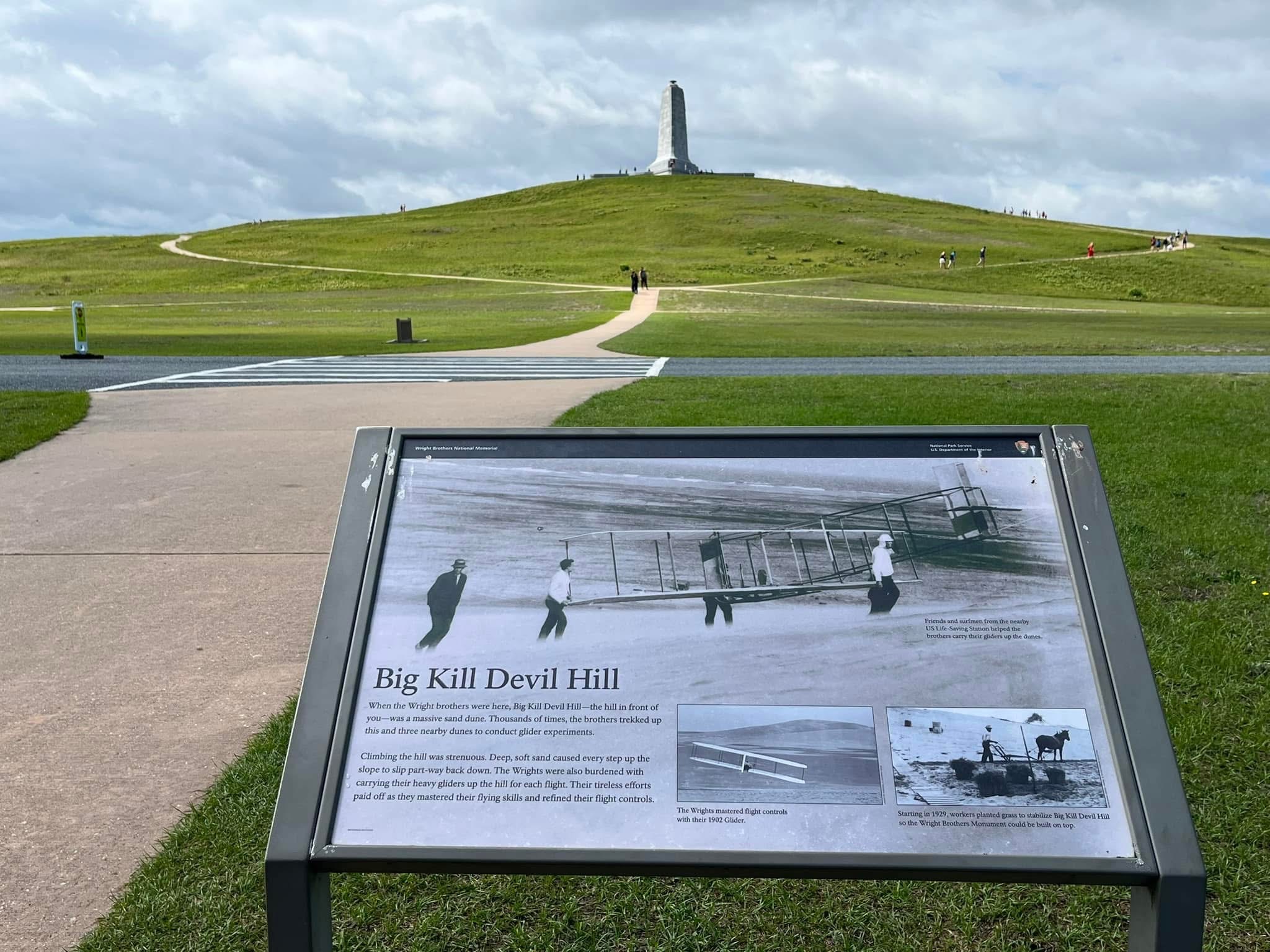
We had a lovely time in Kill Devil Hills sipping hot chocolate on a covered balcony overlooking the ocean while it rained, spending time visiting and talking, visiting the Wright Brothers Memorial (first time) and being blessed with the sight of a beautiful, enormous rainbow over the ocean, the photos of which do not do it justice. Oh, and watching a beautiful sunrise after the rain moved out. 

Yeah, Plan B was definitely better.


The Lost Colony: Reconsidering My Conclusions

Before reading this post, it would be a good idea to read or even skim my previous posts on the Lost Colony.

As I once again considered what I thought had been the obvious answer to the fate of Sir Walter Raleigh’s last expedition to the New World—that they simply went to live with the Croatoans on what is now Hatteras Island—I realized a few things didn’t add up. If the colonists (and the Croatoan for that matter) had been on Croatoan, they would have seen John White’s ships as they had during previous expeditions. Someone would have run out to greet them as they had in the past. Especially Eleanor Dare. So it appears they weren’t there. Some would say they had moved "into the Main" as they discussed at some point. If that was the case, why didn't they leave another imdicator for John White? And why did they leave behind so many items that could be useful later in life?

After further research, I began to suspect the answer was because most of them were dead. I put together some facts:

At the start of the second voyage in 1585, Lord Grenville sent a ship to retrieve thirty men left on Croatoan by the captain of the Lion. They found “two men and no explanation of the fate of the others.” Twenty eight people are dead.

A year later, upon returning to Roanoke and learning Ralph Lane and his men had abandoned their post, Lord Grenville left fifteen men on Roanoke Island and went back to England. A year later, John White “found the bones of one of (those) men and no indication where the others might be.” Forty-three are dead.

In both cases, the groups of soldiers were attacked or killed shortly after the ships (which would have looked formidable to the natives, and represented power, strength and shelter for the English when they weren’t wrecking along the shore) and the groups’ leaders disappeared across the sea.

Fast forward a year later to the arrival of John White’s colonists in 1587. Not long after they disembarked, one colonist “was ambushed and killed while crabbing alone without armor or weapons. He was struck by sixteen arrows and then clubbed to death with wooden swords.”

Forty-four are now dead.

If forty-three soldiers in two groups had been killed after being left on Outer Banks islands and one colonist brutally murdered when caught alone, what reason do we have to believe that a group of civilians could have stood up against the Secotans and possibly their allies after White, the ships, and any protection the colonists had at their disposal had left?

Like other nations, the Secotan killed their enemies, and thanks to Ralph Lane’s heavy handed rule on Roanoke Island the previous year, the English were now the enemy.

And then there’s John White’s return in 1590. He saw the palisade the colonists had to build, indicating an imminent threat had existed. The distress token wasn’t carved in the tree above the location, but some items had been left behind. Those items had been scattered around long before that and damaged. Why? Because some or most of the colonists had been ambushed before they could retrieve them? Some of the Croatan too, including Manteo?

The night of, and the following day after, his return to Roanoke three years later, John White saw several large fires and fresh footprints in the area he expected to find his people. That caught my attention. Over the years I’ve learned some natives had a habit of tossing enemies they killed into piles. Perhaps the Secotans did as well in this case, or they just scattered the bodies of dead colonists around as they did the items they found inside the palisade. When years passed and no additional colonists arrived, perhaps they assumed they had achieved their goal of ridding the area of the English. Then, when they spotted more ships approaching from the horizon, perhaps they set the bodies or other evidence on fire to dispose of it for fear of retribution. Perhaps John White saw something to that effect in the ashes and knew his people had been attacked.

Why wouldn’t he just say it? Perhaps he did. Perhaps it was suppressed. The land was still Sir Walter Raleigh’s patent granted by Queen Elizabeth, and Raleigh still had financial and military interest there. There was no such thing as free speech. White didn’t even write about the last voyage until 1593. Raleigh had fallen out of favor with the queen by then. The year before White wrote about the voyage, Elizabeth had Raleigh imprisoned in the Tower of London. 

That’s a lot of maybes and perhaps, I know. Questions remain and we can only continue to guess as to what happened. I do believe some of the colonists survived. That’s clear from the accounts of John Lawson and other explorers who attempted to find them. If the majority of the group, especially the men, had been killed, the few remaining colonists would have had to assimilate with surviving Croatoan, later known as the Hatteras Indians. It explains, as John Lawson wrote in 1701:

“These tell us that several of their Ancestors were white People, and could talk in a Book [read], as we do. The Truth of which is confirmed by gray Eyes being found frequently amongst these Indians, and no others. They value themselves extremely for their Affinity to the English, and are ready to do them all friendly offices. It is probable, that this Settlement miscarry’d for want of timely Supplies from England; or thro’ the Treachery of the Natives, for we may reasonably suppose that the English were forced to cohabit with them, for Relief and Conversation...”

Before all this started, I believed the colonists, now abandoned, joined with the Croatoan and eventually assimilated with them. After taking all these facts into consideration, I think there’s far more to that theory. Given the pattern of natives killing any newcomer they found (it’s important to note that this pattern extended to the Jamestown settlers in 1607) I no longer believe the vast majority of the 118 people who traveled to ‘Raleigh’s Virginia’ in 1587 survived for long after the departure of those formidable ships and the colonists’ leader, John White. Likely only a few survived and they would have been at risk for the rest of their lives. Since no one found them during early 1600s expeditions, they may have all been gone by that time with the exception of the children, who were more native than English. 

And since the Croatoan didn’t come out to meet the ships—not even Manteo—I suspect the Secotan attacked them as well for helping the English. Even if that didn’t happen, they weren’t on Croatoan as they usually were. Were they staying with whatever group the Croatoan later merged with to form the Hatteras tribe to protect themselves? Seems reasonable. Years later, Hatteras Indians, presumably ancestors of the Croatoan and the surviving colonists (whichever colonists had gray eyes) were back on the island, so they didn’t go elsewhere for long. They returned to their homeland at some point in time.

As I said, that’s a lot of maybe’s, but it’s the most reasonable—and sadly, logical—explanation as to the fate of the Lost Colonists. Hopefully, new evidence will come along to prove that theory wrong. 


The Lost Colony: John White’s Journal

As I mentioned in a previous post, I began to question my previous conclusion of the fate of the Roanoke Island Lost Colony. The source of my doubts was John White’s behavior during his 1590 search for the colonists and his eventual abandonment of a group that included his only daughter and granddaughter. Further research was needed. One of the sources I used was John White’s journal of his final trip to Roanoke Island in 1590: 

http://nationalhumanitiescenter.org/pds/amerbegin/exploration/text6/white.pdf

Some details, while not quite answering my questions, swayed me into keeping an open mind as to the reasons White and company left without stopping at Croatoan. Other details confirmed the direction of my suspicions. Read it for yourselves a few times. Take notes. 

The Lost Colony: The First Expedition

A Look at Roanoke and the Lost Colony


As I mentioned in a previous post, there are so much facts and details involved in events that led up to the disappearance of members of Sir Walter Raleigh’s third expedition to the New World, numerous books had to be written to present it all. What follows is the barest of facts. If you would like to learn more, see my second post for a few resource recommendations. 

Raleigh’s First Expedition: 

In 1584, Walter Raleigh received a patent from Queen Elizabeth to establish a colony in the New World. He wanted to settle “at the edge of Spanish territory.” Queen Elizabeth refused at first, but changed her mind after the Spanish attacked English ships. 


In  July 1584, Philip Amadas and Arthur Barlowe landed on the Outer Banks of what is now North Carolina. They eventually made their way to Roanoke Island. The expedition was a smashing success. With the exception of one encounter that may or may not have happened, it was everything one would hope first contact would be and wished that it would have been throughout the ages. During their time there, they were hosted by members of the Secotan Confederation. 

For a short summary and chronology of the expedition, go to the National Park Service’s page on Amadas and Barlowe.

Camping at Pilot Mountain

My husband and I haven't been camping in years. Not since two drunk bubbas at Tyler State Park spent thirty minutes saying, "I love you!", "No, I love you!" to one another. Which wouldn't have been bad had it not been somewhere in the vicinity of one in the morning. And they hadn't been yelling. Between that and the cold ground, hubby said that's it. No more.

He almost changed his mind about ten years ago. We'd moved to the Carolinas and discovered hiking, and the thought of spending a night outdoors once again held an appeal. We purchased a two-person tent we found on sale along with two mummy, or cocoon, sleeping bags. All geared up now, we camped approximately zero times. The tent didn't even come out of the box.

For reasons I can't remember, late this past summer, we decided it was time to go camping. I found the tent, and we took it out back and set it up.

Somehow that little tent had shrunk as it wasted away for years in the closet, and as we stared into a tiny space we knew we wouldn't be comfortable sleeping in, we decided it was get a bigger tent or forget about camping for good.

Not long after, we found a great deal on a two-room tent, and this past weekend, we drove to Pilot Mountain State Park and camped for two days.

We had a great time. A hilarious one as well from the start when we realized our new, roomy tent was bigger than the tent pad.


You can't see it in this photo, but the tent is hanging over the side in the back.

Despite that, a roomy tent made for comfortable camping. All went well until it was time to start a fire.

As I mentioned earlier, we haven't been camping in years, so we've had little reason to start a campfire. We tried using leaves as kindle. We tried little branches. We tried paper. But no matter what we burned, the firewood we purchased from the park would not ignite. Thankfully, my husband had purchased a small gas grill for the trip, so we had enough heat to cook our food. But a nice cozy campfire would have been nice!

We spent the next day hiking to waterfalls at nearby Hanging Rock State Park. When our legs refuse to walk any further, we headed back to the campsite. A nearby camper, a brother in the Lord who took pity on us, gave us a Duraflame starter log. That night, we make fire!


As it turned out, the firewood we'd purchased was newly cut and was still moist. The foam and popping noise it made as it finally ignited soothed our bruised egos.

Another hurdle we had to overcome was learning to sleep in the cocoon sleeping bags. In a regular sleeping bag, when one wants to turn onto one's side, one just turns inside the sleeping bag. During the second night, I finally figured out one must take the entire cocoon sleeping bag with them if one wants to turn. I felt like a little worm. But I was grateful for that bag in the middle of the night when temperatures dropped into the 30s. It may have been constricting, but it was extremely warm.

Overall, we had a fantastic time camping in the woods, cooking over an open fire, hiking to waterfalls, and just spending time together outdoors. I'm pleased to report my husband said this will be one of many camping trips to come. And with scenery such as this, I'm grateful.


A Trip to Western NC

Friends often comment on our comings and goings, and during our recent trip, one asked, "Where is Kimberli now?" What most don't realize is that we live in the rural country in the midst of farmland. For people who enjoy being on the go and who also love the outdoors, comings and goings are essential, even if the long drive does exhaust us.

But this past week, we took a real vacation. A check-into-alternate-lodging-and-stay-an-entire-week vacation. Not driving five or six hours one way, spending one day trying to get in as much as we can, and then backtracking the next. It was grand, and we had a great time in Bryson City hiking and biking the roads and trails there.

I'm still sorting through photos, though I only took 249 for the week. I plan to have at least one post up on Carolina Towns and Trails this week, and after I work on my novel, I'll write a few more.

Hint, our trip involved encounters with elk, a bear, and a young man climbing up, then slipping down, a waterfall.

Oconaluftee River, Great Smoky Mountains, Copyright KBuffaloe

Hiking Obstacles

I had a nice lesson from the landscape this past week. We traveled back to South Carolina for a conference, and after the close of the event, we headed to the mountains to hike.

I've been gone so long, I had forgotten many of the forest roads and more portions of the Parkway than I realize are closed during winter. Sure enough, both the Parkway near Cold Mountain and Forest Road 475b were closed.

We got a bit of hiking in despite the obstacle by revisiting old favorites: Pearson Falls near Saluda and Dupont State Forest near Brevard.

Upper portions of Triple Falls, Dupont State Forest, Copyright KBuffaloe
Lower portion of Triple Falls, Dupont State Forest Copyright KBuffaloe
Pearson Falls, Copyright KBuffaloe
I'll take it.

Getting Caught Up

Last month, we visited friends and a few destinations in western NC and the SC Upstate after plans fell through for a conference. The timing was perfect, and we saw the Blue Ridge dressed in autumn colors.

My favorite mountain pass
Here's a link to my post regarding our visit to NC's Chimney Rock State Park: http://carolinatrails.blogspot.com/2013/12/chimney-rock-state-park.html 

The post is short, but that's by design. Any attempt to cover all the wonders of Chimney Rock would have led to a lengthy post even I wouldn't read. The geology alone would take up an entire post. For those not aware, part of the reason the landscape looks like it does is due to a fault time, which I hear is visible from a vantage point off the Skyline Trail. North Carolina consists of several terranes, so it has several fault lines, some exposed. See http://ncgeology.com/

On the working front, I submitted an article to the magazine I've been writing for this past year, but the issue isn't going to press as originally planned. I'm disappointed, but not for the reason you may think. The history turned out to be fascinating and I was looking forward to sharing it with readers. Right now, we're tentatively looking at a February release. I'm also in the midst of rewriting the sequel to a much-beloved novel, and was recently tickled to learn its prequel advanced to the semifinal rounds of a national contest. More on that later!


Back from the Mountains

This past weekend, my husband had to attend a class in Columbia, SC. We decided to leave a day early for an overdue trip to the mountains. And oh, what a good decision that turned out to be.

The Blue Ridge Mountains are breathtaking on any given day, but more so when the air is clear, as it often is during the colder months, and when autumn is still infused in the trees. The leaves had fallen in the higher elevations, but the color was still brilliant from Hendersonville down through Columbia. We took our first visit to Jump Off Rock, a place I thought was in the mountains of Upstate SC, and we're so sorry we didn't know about this place while living near there. Such gorgeous views.

Below is a panoramic I created in Photoshop using a series of pictures I took. For a larger version, click on the pic.


It's even better in person.

Rachel Carson Reserve

I know this belongs on Carolina Towns and Trails, but I still have to research estuaries and their importance before I post there. Today we traveled down to the Rachel Carson Estuarine Research Reserve (that is so hard to type), located across Taylor's Creek in Beaufort, NC (the island stretched across the bottom of the photo, below). We couldn't find a trail that led to the ocean side, but we did hike into the interior of the western tip of the island.

With sandy soil and evergreens, the terrain is sparse, and we fought burrs working their way onto our socks even as we enjoyed the sight of Sun Blankets teetering in a slight breeze. But it's a great sanctuary for wildlife, and we spotted two of the wild horses that live on the reserve, along with oyster napping in their beds, pelicans, ibises, a heron, an osprey, and two types of crabs. It's times like these that I wonder if I visit Carolina destinations so I can blog, or I blog so I have an excuse to visit Carolina destinations!
A few photos:

During the three minute ferry ride across the creek, we spotted this wild horse grazing near ibises:


The ferry, piloted by Captain Farmer. Beaufort is in the background.


One view of the reserve:


Fiddler-type crabs scuttling toward nearby brush:


Close-up of a little guy who decided to take us on:


We soon happened on one of his larger cousins:


One of the wild horses. I have a better photo that I'm saving for the CT&T post:


What we believe is an osprey:


And last, for this post anyway, a photo of a butterfly that landed on a nearby Sun (Indian) Blanket:


A rugged little getaway just yards from Beaufort, NC.

Surf City

No kayaking yesterday. Most of the tour companies are either opened on the weekend or open full-time in mid-May. But the idea put salt water in our veins and we headed to Surf City. Sandwiched between two Topsails——Topsail Beach and Topsail Beach——Surf City is one of those typical beach towns. Cars are crammed in parking lots and along the road, and tourists swarm the pier, the beach, and those two-story souvenir shops with murals of large aquatic creatures painted on the side.

We found a spot just above the tide line, and stuck our beach umbrella in the sand. Lying on a couple of  grass mats, we picnicked, took photos, and enjoyed the sight of foamy whitecaps roiling on the shore. Overall, a great day.


Good Idea or Not, We Went

Thirty-something degrees outside this morning and after a half-hour of discussion, we decided to run to the Outer Banks to visit Pea Island National Wildlife Refuge. Why? Why else—to search for snow geese.

It's a very long drive to the Banks, but, eh, it was Kell's day off. We could spend it sitting around the house listening to talk of health care and Tiger Woods, or sitting in the car driving around the great outdoors. Outdoors won, hands down.

For the record, it was bitterly cold on the Outer Banks today. The wind whipped, soaking through our jeans and stinging what skin we couldn't cover. We spent some time inside Pea Island Visitor Center viewing birds floating around the marshes through spotting scopes, and a little less time standing on the side of the road taking pictures. And yes, we did see snow geese, thanks to one of the park's volunteers. He not only led us to them, he brought his scope and binoculars along so we could get a closer look. We froze, but what a great way to spend the day.

Tundra swans:


And snow geese:

Black Mountains

During a visit to Mt. Mitchell several years ago, I picked up a copy of A History of Mt. Mitchell and the Black Mountains at the state park's gift store. It sat on my bookshelf for years, squeezed between Tales of Edisto and Bushwackers, but I finally cracked it open last month. I'm sorry I waited so long to read it.

Beginning with the Pisgah tribe, author S. Kent Schwarzkopf takes the reader from the earliest known history of the Black Mountains through initial exploration, logging and tourism, all of which changed the face of the once isolated range. I learned about Andre' Michaux, whose name I'd previously associated with explorer John Lawson and an orchid, and the true nature of the controversy between Elisha Mitchell and Thomas L. Clingman (it was not, as is frequently reported, a dispute involving a peak in the Smoky Mountains.) I read details of Reverend Mitchell's death and the search for his body, and the invaluable work of Arnold Guyot.

A History of Mt. Mitchell and the Black Mountains is a must for anyone interested in that particular range, or in North Carolina history. It's available at Amazon, Barnes and Noble, and many gift shops along the Blue Ridge Parkway.